
This is not my first post on the topic of peer observations, but a recent study made me scream with excitement. It validated what I’ve experienced in my own professional development: observing other teachers in their classrooms has made me a better teacher. Now, research involving English secondary schools links the frequency of these observations to higher student attainment. Even more importantly, the greatest impact is seen when fellow teachers, rather than senior leaders, conduct these observations.
A study conducted by Bernhard et al. (2024) explores the relationship between classroom observation frequency in English secondary schools and student Progress 8 scores. The study involved leaders and teachers from 151 schools of various types. These schools include state-funded academies and maintained schools. Their Ofsted ratings range from Outstanding to Requiring Improvement. On average, both leaders and teachers were reported to observe classrooms at least once a term. Although the study does not specify which observations were linked to appraisals or which were informal, the data reveals an interesting insight. Classroom observations by leadership, often related to quality assurance, show no significant link to student progress. Yet, students in schools where teachers frequently observe each other make more progress compared to their peers. Predicted Progress 8 Scores positive correlates with the increase in frequency of observations by teachers. Any observations at all within an academic year has a positive impact on student attainment.
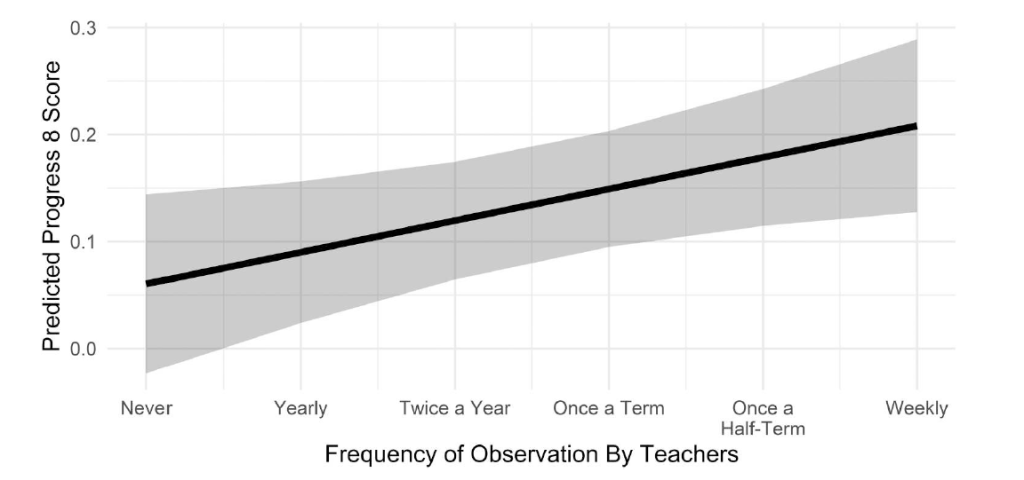
Predicted marginal effects of frequency of classroom observations by teachers on progress in students attainment (i.e Progress 8)
Previously research into observations carried out by peers within teaching has been limited. Jackson and Bruegmann (2009) found that teachers improve more when they work with effective colleagues. Papay and Kraft (2016) found that veteran teachers, who have taught for over 10 years, improve within a collaborative environment. This study by Bernhard et al. (2024) concludes that observations done in the “right way” centering around teachers’ professional development rather than primarily serving to monitor teachers have the greatest effect. Encouragement by leaders of staff to adopt an open-door policy to invite peers to observe teaching and then provide one another with feedback has a direct impact on whole school student attainment.
Interpreting this study into our schools
Does this mean we just teach with open doors? It’s not that simple, a culture of peer-on-peer observations doesn’t develop overnight or even over a term. The perception of observations by teachers holds many negative connotations. For many years, high-stakes observations in teaching caused many teachers to freeze. They feared another adult coming in to watch them teach. I remember myself suffering from nerves and even anxiety rashes when I had another teacher in the room. I have only felt truly comfortable in recent years where the observations became low-stakes and conducted within a positive environment.
The first step is to create a culture where drop ins are celebrated. People should talk about the positive aspects of teaching they have observed. This can be through personal discussions. Alternatively, you can use a whole school public platform like the Steplab Shout-outs function. Who doesn’t like to hear where they’ve been successful?
Once that positive culture is built, then you can incorporate constructive feedback into the conservation, but still the positives always lead. Leaders too need to focus first on the positives during QA learning walks. They are instrumental in driving the low- stakes observation culture.
Time is a crucial factor not investigated by the study. It shows that weekly observations have the greatest impact. However, this is often not easily achievable within a busy teaching timetable. Therefore, observation time should be integrated into the whole school professional development program. One effective method for doing this is through whole-school instructional coaching, which involves a cycle of observation and purposeful feedback while remaining time manageable for classroom teachers. Once teachers recognise the positive effects of observations, they will be more motivated to observe teachers informally outside of PD parameters.
If you are a teacher, consider inviting a colleague into your classroom and ask them to share what they notice. If you are a school leader consider how to make peer observations a regular part of professional development. Focus on growth rather than judgement. Our school promotes peer on peer observations through regular timetabled WOW (Watch other work) weeks. During these weeks staff are encouraged to invite their colleagues into their classrooms to observe practice. The journey towards an open-door culture isn’t fast or easy but with positivity, it’s one that promises a lasting impact for our students and our profession.



 Teachers Notebook
Leave a comment