
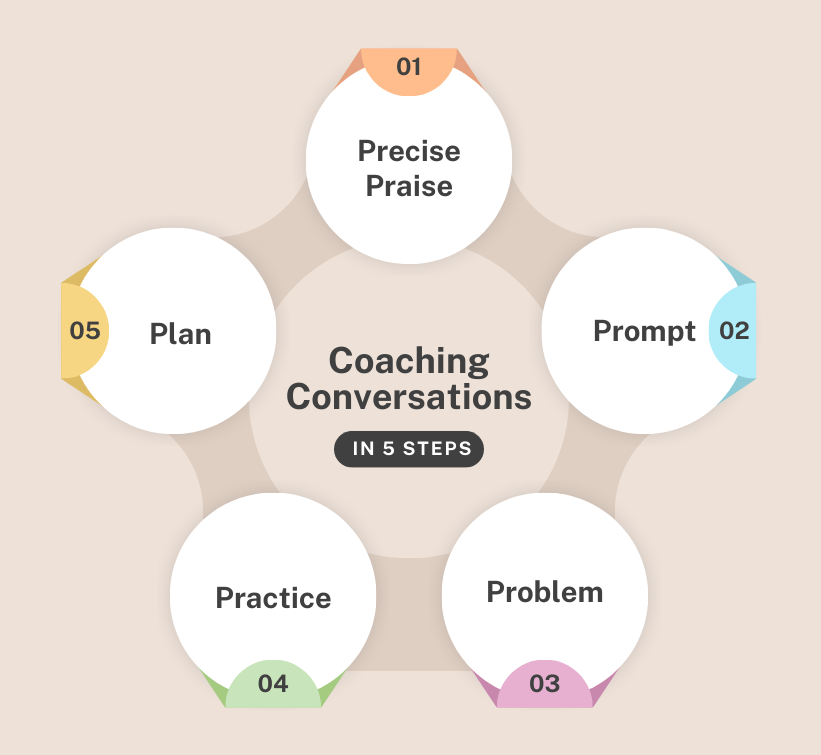
What makes coaching different to mentoring? Coaching is a process of professional reflection harvested by another teacher who is your eyes and ears in the classroom. A coach allows you to explore your own understanding of pedagogy and reflect on refinements that will make an impact. So how do you lead a teacher colleague to their developmental step without telling them what to do. This is where the beauty of coaching begins.
Coaching is not a prescriptive one-way advice session or simply a friendly discussion. It is a conversation with a purpose. Coaching conversations follow a guided process and framework, this is where our whole school use of Steplab offers support to novice coaches with a clear feedback section dedicated to the probe section of coaching. A coaching conversation should be coachee-focused and the coach should mainly listen and ask timely questions. It is also an opportunity to focus on the future and find solutions, shifting perspectives and take action towards an achievable goal.
The prompt or exploration stage of a coaching conversation is planned to happen after the precise praise. It is a time for coaches to use skills to support their teachers to self-discovery. The ingredients of an effective prompt include; skills such as asking customised and responsive open ended questions, summarising what the coach has heard for the coachee to respond to, offering observations of what the coach is seeing – this is also where lesson video recordings are helpful and also opportunities for the coach to delve into the science of learning with the teacher.
It is all too common for coaches to use their own personal experiences to lead their colleague to a next step through a “When I’m teaching I do……” or “What I would have done at this point is …….”. However, this is not allowing personal reflection and exploration. It creates a tone where there is an imbalance of power – mentor vs students rather than two professional collaborating. This is why I recommend that coaches carefully preplan their prompt and even use a preprepared script containing explorative discussion points.
What does the coaching ‘prompt’ section sound like?
Here are some question stems that I have used effectively during coaching conversations:
- “Today I want us to talk about the moment when……. [specific element of lesson, action step area]”
- “At this moment during the lesson, what was occurring with …..”
- “Let me show you a model of how it could look….”
- “What is it about the model that makes it effective?”
- “How was the model different?”
- “What do you think the impact of ……….. is?”
Another effective way to open the conversation is to watch back on video a section of the lesson together and highlight where you wish the teacher to focus e.g “As we watch back this short section of the lesson, watch the behaviour of students at the back of the room”. Now you have their focus to ask prompt-questions after the video. Often teachers have a ‘wow’ moment here and can identify what their incremental step is which you can go on and explore further.
With novice teachers, who have less classroom experience and knowledge about the science of learning, again begin with an explorative prompt. You may need to interject and use more direct questions such as “During the Do Now how many students were independently working?” “How could you ensure there is a higher participation ratio at this part in your lesson”. But as your coaching relationship develops you can reduce the direct questioning and more towards a more open-ended discussion.
Coaching conversations don’t always go in the direction that you want. Imagine this scenario – You have carefully chosen a next step for your colleague however during the prompt where you are leading them towards this step they go off on a tangent in a completely different direction. In this case I would acknowledge that direction and listen. Your colleague is self-reflecting which is the climate you want to create. However, to draw back their attention you may say ” Yes let me jot that down and we can come back and explore that in the future. In addition to that point you’ve raised I would like us to explore ….”. Coaching isn’t a one-off occasion; you are on a journey together. Furthermore, the use of video here can keep the conversation on track. Direct your colleague to a small timeframe of their lesson, highlight the explicit area of the lesson you wish to explore with them keeping their attention with the video.
The prompt section is a section that I too would like to improve as a coach. I still carefully plan this section of my conversation because to me, this is where the magic happens. This is the light bulb moment of self-reflection and also where the coachee has the power to change. Change doesn’t happen if you told about it, it will only happen if you are involved in it.



 Teachers Notebook
Leave a comment